Showing posts with label Haiti. Show all posts

06 June 2013

Which one are you? aka MMMM Book Review

When I was in Haiti, I often said that the stress of it all would end up making everyone a smoker, alcoholic, adulterer or anorexic. Or all 4.

One NEEDED the vices in order to just keep a grip on reality.

Ok, if you were really smart, you would just channel it all into a good workout at the gym. Or actually learn to escape – physically, mentally, emotionally (Cocoye trip anyone? Or how about even a day at Karibe, where we can pretendlike we don’t know that loud group of Americans or MINUSTAH sitting next to us?).

****
And then Disastrous Passions began – a blog documenting the Harlequin-romance-like life of young aid workers in Haiti, falling in and out of love and lust. And it was like someone was following my life! Well, maybe not mine… but it was like a Gossip Girl-esque entity had arrived in Haiti and began documenting all the gossip that emerges out of the need to escape and all the debauchery that ensues.  And who doesn’t love to find out what’s reallyhappening around outside of the office.

“Gossip Girl here. Your one and only source into the scandalous lives of Petion-ville’s aid workers.”

Not that it was true…or so the author, J., wants us to believe. But some of it sounded distinctly familiar to REAL stories I was hearing around town.

Well… Real or not, this blog-turned-book (yes, I was most definitely was one of the first to purchase it) was written by someone who knew. An insider who was telling the story in a jargon that only those who knew as well would understand.

I must admit I have read it a few times…sometimes when you were sweltering alone in your room in Leogane, hoping that the mosquitoes didn’t get too bad, that the inverter would stay on so you could keep entertained by your computer / internet, and daydreaming (or night dreaming) about that hot, loggie Irishman you just met, a read of the self-proclaimed humanitarian romance fiction was just necessary.

Buy the book here!
So when the author contacted me and asked if I would review the next instalment in the series, Missionary, Mercenary, Mystic, Misfit or MMMM, I quickly jumped on board. Ok, I was EXSTATIC! Find out what happens next to Mary-Anne and Jean-Philippe? Yes please!

And yet again, this book feels like it is telling the story of my life. It picks up after Jean-Philippe, the established, French aid-man, had moved from Haiti to Nairobi to be with Mary-Anne, the innocent, American programme officer and love of his life. But Mary-Anne is pulled away to Dolo Ado, Ethiopia and the Somali refugee response, while Jean-Philippe traipses around the world attending “life-saving workshops.”

Mary-Anne is faced with new situations, new faces, and potentially a new man – the classically named, Jonathon Langstrom. The book’s abstract reads (an excerpt): “Now, with a new organization in Dolo Ado, Ethiopia, she struggles to balance life, love, and career in the wake of ARRA’s decision to open a new refugee camp at Bur Amina. Will this new opportunity stretch her to the breaking point? Or will she rise beyond the challenges? And what will become of Jean-Philippe? Will their prolonged separation cause their hearts to grow fonder? Or will she find comfort in the arms of the mysterious, brooding Jonathon Langstrom?”

Now, I don’t want to spoil the book for you all aid workers who are going to (i.e. should) read it.

But it’s good. And no, J. didn’t pay me to say that.

Ok, honestly, sometimes it is quite negative and/or snarky – BUT anyone who has ever worked in a response knows that there is a heck of a lot of negativity. And J’s reputation of snark precedes him.

And sometimes it a bit dramatic – but AGAIN, for anyone who has been there, drama tends to travel ahead, around and behind any semi-effective emergency response.

BUT… And now the real buts start…

This novel is not written for the general public. Seasoned aid workers may get annoyed with it. But it’s not attempting to provide answers – nor should it! It’s fiction. But for those of us who are living the humanitarian life, whether you are at the beginning, middle or end of your career, will recognise yourselves or others in it.

There’s a lot of reality in the book. It deals with the questions that every aid worker has asked themselves at one point or another. It deals with the career move questions that we all ponder. It talks aid philosophy, work-aid-life-balance, that odd disconnect we have as ‘expats’ living with ‘national staff.’ It talks about the states that all humanitarians end up in at one point or another – as Missionaries; as Mercenaries; as Mystics; as Misfits.

And, of course, it ends ‘To be continued…’ as all of our stories (i.e. lives) do.

And we have J, our own Gossip Girl, to tell it. ("And who am I? That's one secret I'll never tell. You know you love me. Xoxo, GossipGirl")

Although, J? I most definitely did NOT agree with Mary-Anne: “The St. George was just okay. Better than Prestige. Not quite as good as Tusker.”

I haven’t tried St. George. But Prestige is DEFINITELY better than a Tusker.

What I wouldn't give for a nice, cold Prestige right now. Or maybe some Barbancourt…

And, please stop following me around, writing/predicting my life. It's getting awkward.

***
Just in case you didn't get it from all the links above...
Missionary, Mercenary, Mystic, Misfit Facebook Page: Here
Missionary, Mercenary, Mystic, Misfit on Amazon: Here
J's Author Page on Goodreads: Here

And 2 more reviews here and here...and more to come this month!

02 June 2013

Unexpected

One of the things about doing the work that I do - living internationally and all, travelling around from place to place - is that you meet a lot of people. And each person has a purpose. Some, they are there to entertain you just for an evening. Some are there to give you company while you are in that location. Some will be long term friends (although this is more difficult and less likely). 

And some are unexpected. As in, you meet for a night or two, have great discussions and then move on, thinking that you will never see them again. 

Fast forward to this week, when one such person, has re-entered my life for the 3rd time...unexpectedly.

I first met T on Christmas Day 2010, in Haiti. I had just arrived in country, didn't know many people, so when I was invited by some colleagues to a Christmas dinner at another NGO house, I of course accepted. It's kinda lonely spending Christmas by yourself... 

When I arrived, I noticed T - he's kinda hard to miss, with big eyes, big arms, and a big Cockney accent. We chatted a bit about life, living in Haiti and such and then moved on. 

I think we were all out on New Year's eve too. 

I next met T in August of 2012 - over a year and a half later. He was living with a good friend of mine in Haiti, working for another NGO. And even though I had been over to my friend's house many times and had even talked with him on the phone, I had never met his roommate, T. So on my friend's last night, we all went for leaving drinks at their favourite place. 

As soon as I walked in the restaurant, I knew I had known T, but neither of us could remember from where...it was only on a random discussion around Christmases spent abroad that BAM! I remembered...


And that was the second time we met. I never saw him again in Haiti. 

Now, T, my good friend and I are all working for the same NGO. T works in Malawi (just moved), my friend, B, lives in Ireland, and I am in Kenya. So, even though that may bring us a little closer together professionally, the likelihood of all 3 of us being in the same place at the same time was slim-to-none. 

Or so we thought. 

We took a lot of photos. This was the best one.
This past week, all 3 of us were in Nairobi together. Both T and B had booked last minute trips to/through Nairobi for completely different reasons. And I live here, of course. 

Let's just say that a fun night was had, reminiscing and laughing and making fun of each other.

I love it when life throws unexpected things your way. Like friends who unexpectedly move from someone who you barely remembered to someone who you will probably go visit at some point. 

06 March 2013

Degrees of Separation

They say that there are an average of 6 degrees of separation between any individual on the planet. 


Via
In fact, in looking for a photo, I discovered that social scientist Stanley Milgram (of the infamous Obedience to Authority experiment) tested this theory as well, in what he called the small world theory. He found that between any individual and some other random individual, there is an average of 5 people in between. Hence, the 6 degrees of separation. 

In the NGO world though, even though it is a world that spans the globe, it is much smaller. 

Some might argue it is too small. 
***
A few weeks ago a logistician friend of mine in Ireland had to conduct a logs induction for 2 people he had never met before - never even heard of. A man and a woman who were being deployed to 2 separate countries shortly after that. Indeed, the man and the woman being inducted had not met, nor heard of each other either. 

So the scene is set - 3 complete strangers sitting in a room together talking about logistics.

Now, this friend of mine is very chatty, so of course he started talking with these 2 about their past experience, where they had been, where they are going, what they will do there... 

And it is in this process that he discovers that they all have one thing in common. 


ME. 

(ok, and my old housemate in Haiti too - so 2 things in common)

Yes, sitting in that room were 3 people who had never met nor had any knowledge of the other peoples' existence, yet all 3 of them were acquainted (professionally or otherwise) to me. 

6 degrees of separation? 

Try 2...

(oh, and apparently they all had a great laugh about it then, and then my loggie friend and I had a great laugh about it afterwards)

And that's not the first time that has happened...nor will it be the last...

03 September 2012

Fool Me Twice, Shame on Me

The past 3 weeks or so have been a roller coaster, to say the least. As I commented here, before Isaac came, I was exhausted. There had been a lot happening in life, I was getting tired, emotional, and was quite close to burnout, I expect. But Isaac rejuvenated me enough to get me here to today. 

And today, I am exhausted again. Impatient, short with people, curt, and just need to sleep. 

But you look at my past 3 weeks, though, you would understand. 

3 weeks ago, we had our security measures increased dramatically due to an increase in international female kidnappings. Now, our curfew is at 10:30pm, we have drivers all the time, cannot walk by ourselves anywhere, and have to text and discuss our movements down to the nth degree. When I am in Leogane, where I don't really know anyone, after the office closes, my only option is to stay in the house. Seemingly under house arrest. Oh, and this is only for women...and ANYONE who knows me would know how I feel about that.

Oh, and around that time, a great majority of our management staff were out of the country, which means there was an increased workload on us all around. 

2 weeks ago, we had a tropical storm hit Haiti, during which I was stuck in the house in Leogane. The storm caused damage in our operational areas, which means that I was out on the field doing assessments and planning a response. 

1 week ago, I initiated a more in-depth assessment, while also trying to finalise evaluations, donor reporting, finishing up reports that others never finished, manage consultants, and work with the rest of my colleagues to make the right decisions around our response. While it was great and exciting, it was exhausting. By Sunday, I was beat and needed a day at the beach to recover. 

And then this weekend happened. I had left most of my stuff in Leogane, because I knew I was going to be back there, come Monday, for the week. And I knew I would not need much over the weekend. So, hey, why not make life easier and only bring the essential items back with me (thankfully,  my passport and ipod were on that list)? 

And then the house was broken into on Friday night, any room which was open (mine included) was gone through and things were taken. Including my bag of clothes. With probably about 3/4 of the clothes I wear regularly here, underwear included. I didn't know about this until this morning, when I got to Leogane, walked into my room and the bag was gone. No hope of finding anything. Well, my trainers were recovered in the banana plantation out back. Woo. Thanks, thieves. 

So, I am back to being exhausted, frustrated yet slightly emotionless. I am ready for a break. Haiti can get to you, sometimes - as I wrote here - it can provide you with some interesting adventures. My friend today told me, well, at least you have a story... 

Yes. Haiti has provided me with stories. More stories than I could probably ever share. 

But they are not always the best stories. They are stories that are tiring, frustrating, where you just want to escape. 

Am I a fool for staying? Or maybe I just need an escape for a short while.

30 August 2012

Where Few 'Blan' Have Passed

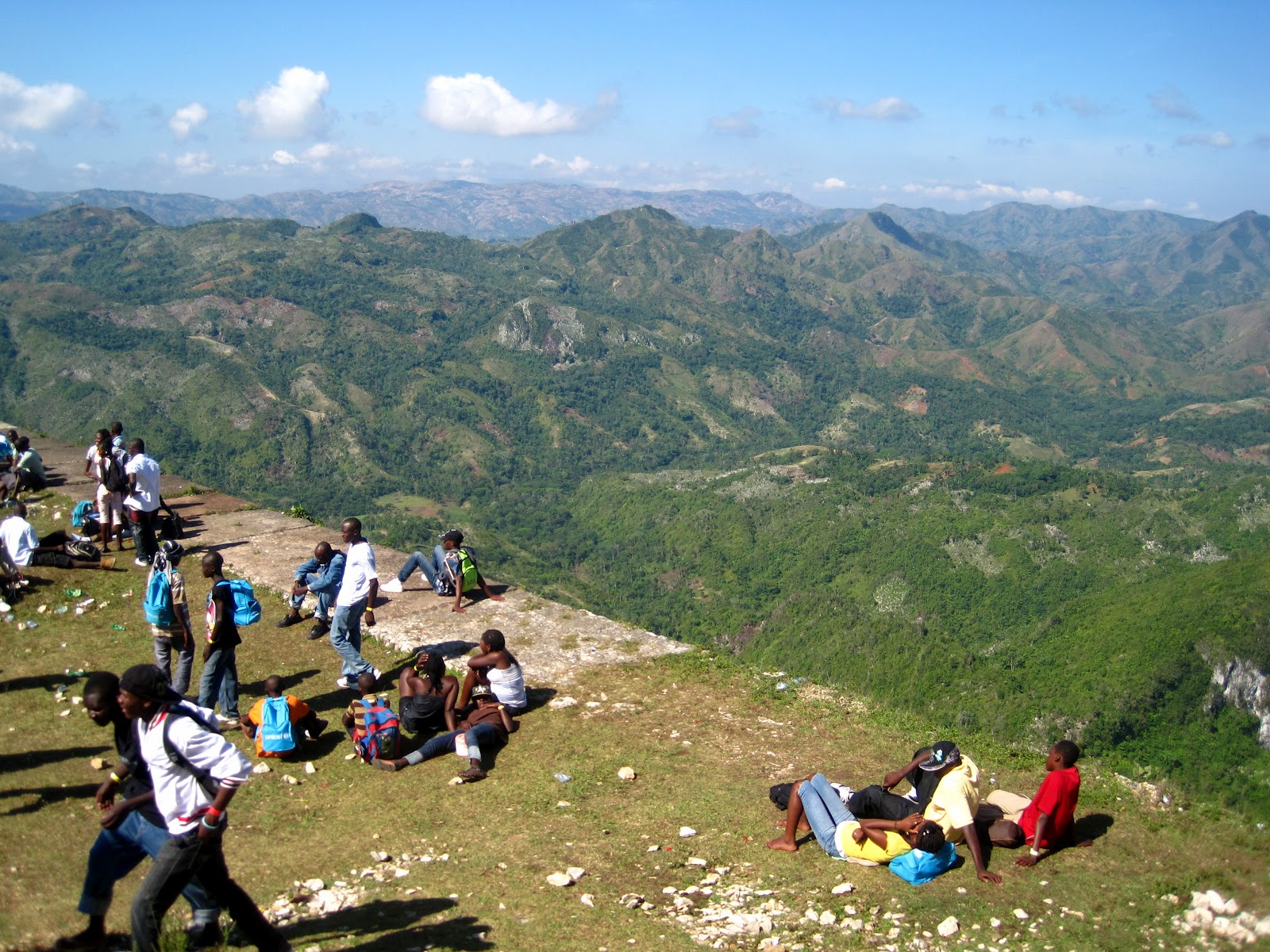
Traversing the mountaintops
I could hear their voices in front of me before I could see their faces, as I marched down the small hilltop path:

'Bonswa!'
'Bonswa!'
'Kouman ou ye?'
'Pa pi mal!'

Greeting each other in the common way. My Haitian team continued walking, and the group returned to their normal chit-chat. 

I emerged from the tall grass alongside their front garden, only to be greeted with a large hoot and holler and laughter from the family members. 

Apparently, blans (white people) don't pass here often. 

I greeted them, as one should to be polite in Haiti, smiling to myself, while they joked down the path to my colleagues about the blan traipsing down the mountain. 

***
Yesterday, I went back out to the mountains to conduct another assessment on the situation left by TS Isaac, this time on the damage sustained to houses in the rural, mountainous villages my organisation works in. 

I ended up going on a 5-6 hour hike down the mountain. 
We were headed to that little peak on the left side of the photo.
and then just continued.
Sometimes its easier to just keep going forward.
***
We were dropped off at the top of the mountain, just where it crests and begins its descent down to the south coast of Haiti. We had every intention to take the car as far as it could go, which as it turned out, was maybe 2 minutes down the road leading to our targeted community. 

In previous days, we had been hearing lots of information from our governmental partners, from various team members, from key community partners about the amount of damage in the rural mountains and hillsides. We had heard of houses destroyed, crops damaged beyond repair, loss of livelihoods, animals killed, rivers flooded. The damage sounded massive and like it needed a dramatic, quick response. 

But, for a multitude of reasons, we didn't trust it - not that we don't trust our staff, but that we don't trust that we share the same definitions of what a word means. And in order to plan and implement a response, we first need to know exactly what the needs are. 

Assessment team - in action.
And, to be honest, part of that involves an unbiased, undramatic point-of-view, supplied by myself, and 2 other colleagues.  

Ok. We also wanted to just get out of the office and see for ourselves - our adventuresome streaks were kicking in. 

But really, it was just to make sure we understood what the situation was. 

So, when I found myself dragging along behind my team, huffing and puffing, stopping every few yards to observe (aka, catch my breath), as my self-assigned job was (non-Creole speaker here...), I did actually take the time to take in the full situation. 

We had heard that many homes were destroyed, many families were now homeless, some again. 

But I found this was not so. I had set the mandate that we were only to conduct our assessment at houses that were completely destroyed (to perchance end up targeting the person for emergency shelter), but after 5 hours of walking, we ended up with 3 questionnaires filled out. Only one was completely destroyed, in the terms of having to tear down the house and rebuild. The rest were missing roofing sheets, or their tin roofs had bent back. Terrible & damaged, yes. Destroyed, no. 

That is a pleasant thing to find, actually - that the storm was not too bad. 

We also found that people were living their lives as best they could to recover. To the man whose house was completely destroyed, I asked, what will he do to repair the house. He responded that he will just buy wood somewhere and rebuild. Matter-of-fact. That's just what you do. 

Back to work on the fields
Another family were so thankful to have a white person stop by their house, that one of the women kept hitting me and saying thank you for coming, and that they are so blessed by it, and that of course I will do something for them (non-Creole speaker, yes. Creole-understander, yes). 

We are so thankful that the damage to houses was not as bad as expected. The damage to crops, however, was. 

Damage to banana plantations, squash and bean plants
In the free moments I have, when not hiking over the mountains and fording through rivers, I am now sending our staff out to get their cars stuck in rivers, walking for hours upon end to conduct another more detailed assessment to look at what types of livelihoods were affected and the potential increase in food insecurity. 

Aren't I nice?

But based on this, we will now know what the true damage was, and how we can best respond. 

And that is just the beginning ...

26 August 2012

Sur la Terrain


Harvest in the Lowlands
To have a day like today, this is why I do the work I do. Adventure, experience, getting to see local culture, and gaining a better understanding of the needs of the communities we work in - this...this is what keeps me coming back. 

We went out today to do a rapid needs assessment in the communities we work in, looking at what happened during Tropical Storm Isaac. We had been receiving lots of information by phone yesterday, from our 'operations base,' also known as our kitchen table. And the information we were getting was showing that there was a great impact. But we wouldn't know for sure until we went out and verified it. 

We knew that need to verify would come soon, and come quickly, so I was prepped and ready to go with all the tools, the processes, the people we would use. All were aware it could happen at a moment's notice - the green light to go. So this morning when I was just chatting to friends on Skype, taking my time to get the day started, and I got the green light - well...we sprung into action. Our area coordinator had been at a meeting with other NGOs and the local governmental response body (the DPC) to see what needed to happen in our commune. So, when they said we need more information, we said, let's go. 

Within 45 minutes, we had the teams here, drivers here, vehicles waiting, questionnaires printed, areas assigned, and process to use communicated. I led a team going to the lowlands area of the Leogane commune, that which was accessible. 

Many of the communities we work in are only able to be accessed by driving (or walking) up the river, and with the amount of water that dumped on Haiti this weekend, some rivers are still impassable. The route taken by our driver today required the use of our sturdy Land Cruiser to manage the mud, crevices, rocks, and river traversing that was necessary to reach the two communities. 

Since I don't speak Creole, I was in charge of photographing (woo!), taking GPS coordinates and making observations in the area. The other 2 on my team went to houses to ask questions about what happened during the storm and what the need was. 


***
On a side note, I had free reign to walk around the communities, chatting with people, traipsing through mud, wandering through fields, petting goats, waving 'Bonswa' to children. Oh my. Just, maybe the best. I loved my job today.
***

At the first community we went to, I wandered, and we talked to 4 households and the local government representative. We found that overall, the damage had not been too bad in the community. There were trees felled, houses that were slightly damaged, and quite a few goats that got stressed and died (ok, there is a small part of me that finds that hilarious, but goats are a huge source of income in these communities, so the humour I find is just really really inappropriate. Bad thoughts, Ang), and there was a lot of mud. Local gardens were affected, but not many, and there were not really any that were completely destroyed. 

A good find. A relatively good outcome for the community. There will be affects, but walking around showed that the community was living life as normal - sitting on porches, braiding hair, gardening, taking care of animals, managing shops, and chatting with each other. 

We continued up the river to the next community. However, to get there, we had to drive up the river as far as the car would go safely, and then we continued the rest on foot. We removed our shoes, my team rolled up their jeans (damn skinny jeans and not being roll-up-able!), and we traversed the muddy, rocky water, joking about what a nice beach we were visiting! 

While this community was not devastated either, it still spoke the remnants of a massive storm. With all the rain, the river had swollen, taking down plantations and gardens, ruining harvests, and creating new cavernous water-ways on paths. Mud was present; more animals had died; and we heard of 5 houses that had been demolished by the wind. 

While my team questioned houses, I was shown around by various members of the community, all pointing out where the damage was. It was evident that this community would bear the brunt of the storm for much longer than the first. 

But still, the communities continued life as normal. Haitians are notoriously resilient, letting things like this storm come and go and just accepting that it is a part of life. Whether this is a good or bad thing, I cannot say, and that is another topic for another day. 


Life continues as normal - including Football!!!
The walk back up the river caused lots of laughter in the communities I think. It's definitely not every day that they see a 'blan' walking up a river in wet jeans and bare feet. I earned the term 'ou capable' (expressing shock at my ability to hike through mosquito-infested jungles, and traipse up a river in bare feet) by my team. 

The meeting upon my return to the office found that many of the other communities visited experienced the same sort of issues. We are so thankful that it is not worse than this. No deaths were reported; most houses survived. 

I woke up this morning bored at the thought of being stuck in the house another day. Instead, I am heading to bed with more mosquito bites than when the day started, dirty feet, sweaty skin, and a smile on my face. 

Isaac, thank you for not being as mean as you could have been, and for giving me a bit of adventure in the meantime. 

23 August 2012

And we wait...

Isaac over Puerto Rico - headed our way!
Until Tuesday, I was feeling exhausted. So tired, I could not sleep but it was all I wanted to do. It was hard to motivate myself; I was on edge; I wore my 'grumpy pants' way more times than I liked. 

Life was difficult and more than once, I thought, I just need to get out of here. My planned trip to the DR could not come soon enough. I want to walk around, sit at a restaurant, be by myself, shop, eat at Taco Bell, and just be more normal. And don't even get me started on all the dreams I was having about being in Europe. I was in the stages of burn-out. 

And then Tuesday afternoon came. I received an email in the middle of the day from my Dad, entitled 'Isaac', asking if my organisation would evacuate me. You see, Isaac was on his way. IS on his way still. At the time, he was a tropical storm, forecast to move right over Haiti, hitting hurricane strength around the time he breached the Port-au-Prince mountains. 

And we sprung into action. I began thinking about our response; our area coordinator planned our preparedness activities. We put our staff into place. Some were to fill up vehicles with gas; others were to board up windows or move items into more secure locations. 

We watched the movements, made decisions on an almost hourly basis as to what else needed to be done. Conversations were had with our HQ, we planned our money, our phone credit, packed our quick run bags, monitored the news again, made sure our staff were safe and knew how to respond. We know that we need to keep our slotted windows open 2 inches so they don't break. We bought food (ice cream and beer included!) and we have candles for when the electricity goes out. 

In response, we have organised teams who will phone and head out into the field to do assessments, to see what the impact is in the area we are working on. I am working on the questionnaire, our methodology, and making sure that we are getting the proper information about the needs in the communities here. I prepped our teams on the process, I am making sure they have the questions, they have the information. We are linking with the local government to make sure we are reaching all the communities in the area - we are taking the lead in much of the initial response. 

Our staff were enthusiastically available to come off annual leave to help, to stay later at the office to make sure we have everyone's contact information, no complaining about the chance to work on Sunday to respond. 

As we left the office, we pushed our desks together away from the wall. Tarps cover important documents that there is a chance for water to reach. Our staff know that the office is closed tomorrow in prep, and what we will do to respond. 

And now we wait. Wait for him to make up his mind as to what he will do. Wait for him to strike or not. Wait to see what happens. 

But Isaac woke me up. I am still exhausted, yes. But he brought my adrenaline back - enough to finish these next few weeks before my short holiday. 

Isaac, bring on what you will. We are ready. 

27 June 2012

I love my job

I love my job. 
Out for a wander through the community

I love that I love my job. 

I love that I am an aid professional. 

I love that even though I am an aid professional, I still have so much to learn. 

I love that there is always something new to learn.

I love that every day is different. 

I love that I spend some days in the office with a fan directed at my face using my creative juices to write reports to donors.

I love that I spend some days organising logistics to collect data for assessments.

I love that one day recently, the highlight of my day was negotiating to hire moto taxi drivers for the 5 days, for the above mentioned transportation. And succeeding - for the price and time we wanted. 

I love that some days, I work on budgets and with numbers and that it all makes my head go a little wacko (oh, numbers...). 

Crazy Rural Roads
I love that some days, I climb mountains and traverse horrendous mountain roads to prep communities for a donor / VIP visit. 

I love that I am passionate about monitoring and evaluating projects, constantly learning from mistakes, striving to create and implement the best projects.

I love that I get to consult with communities about what their needs are, and how we can work together to meet them. 

I love that I get to network with other INGOs  and local NGO partners to share information, build capacity, and provide assistance and advice. It feels like we are all in this together.

I love that I get to rub shoulders with people from the UN, EU, US government, and more. Ok, it makes me feel a little important (oh, it would for you too!). 

I love that adventure, travel, and new experiences are a constant part of the job. 

I love that by the time my passport expires, I will have (hopefully) been to 30 countries, and have needed additional pages, and filled all of them completely.  

I love that I can get frustrated, scared, feel inadequate, feel like I conquered the world, and feel extremely content and proud - all within a single 18 hour work day. 

I love that when I was looking for new jobs and actually got to the point to consider applying for work outside of the INGO sector that I actually had no idea what else I could do. 

***

I love my job. 

I love that I love my job. 

23 June 2012

6 months...


I just returned from the supermarket, doing our weekly shop with my housemate. We unexpectedly ran into 4 people we / I know. Apparently, the supermarket is a cool place to be.

A few months ago, flying out of Haiti, I randomly ran into 3 colleagues who were flying out at the same time (not same flight though). Apparently, the airport is a cool place to be. 

Last night, I stayed in, but I found out that two sets of friends, who, as far as I know, don't know each other were doing the same 'going out' route. Apparently, all the cool people do the same thing on a Friday night. (And the boring ones stay home. boring = me.)

***

I have heard it said that it takes 6 months of living in a new place for one to really feel settled. As in, for one to feel like they have developed a routine, relationships, habits, and a comfortability with life.

A few weeks ago passed my 6 month mark with my current organisation (which means I have in fact lived in Haiti for over a year) and I am noticing that this fact is true. Six months in, Haiti is my home and I love it in all its craziness and in all its social stability. 

But this also means I have 6 months left. I know I won't stay past my contract (don't worry, I know I won't leave early either!), and I am excited to start considering what is next. 

As much as I love my life here 6 months on, when you start looking at it from the 6 months left side, it starts to get difficult. 

Meeting new people is hard with the knowledge that you will have to leave soon.  

Making quality friendships is hard because you may never see people again. 

The work here never seems to lessen, only to get bigger and more intense. There has never been a day when my to do list has been completed. As Haiti moves from emergency response to development, the process needs to be integrated and it is hard having development professionals come into a post-emergency response, where there might be issues with systems set up, lack of institutional knowledge, or a whole range of things. Anyway, that is off the point and food for another post. In other words - there is still a lot to do. 

***

My first 6 months here were the most difficult time I have experienced. 

These past 6 months have been a challenge and a joy.

The next 6 months - who knows what they will bring. 

But for now, I know I am in the right place.  

16 June 2012

Alumnus

In the past month since I posted last, I have been working lots, travelling lots and have lots of blog posts started but not published. Need to get back onto them. In the meantime, I was asked by my MA university to write an article about my work in Haiti for the inaugural edition of their Alumni newsletter. What an honour! So for those who are interested, I publish it again below!
Link to the whole newsletter here


The day in January 2010 when the 7.0 earthquake struck Haiti will go down in history as one of the most catastrophic days in modern Haitian times. Over 200,000 people were killed, 2 million more displaced, and countless others affected.

I remember that day vividly. It was a Tuesday, and I had just returned home from the Senate house library where I was preparing for our lecture and seminar in Securing Human Rights the next day. I turned on my computer to relax a little before bed, and opened up the BBC news website. As the site loaded a breaking news headline popped up: “Haiti devastated by massive earthquake.” As soon as I saw that, my heart jumped and I knew. This was the last thing Haiti needed.

Prior to the earthquake, Haiti’s history is filled with coup d’états, hurricanes, dictators, occupations, and a constant stream of human rights violations. As the well-advertised statistic says, Haiti is the poorest nation in the Western hemisphere with over two-thirds of its population living on less than $2 per day. An earthquake of this scale, with the epicentre located only 25km away from its populous capital city, Port-au-Prince, had just set Haiti even further back on the development ladder.

As an American attempting to learn French, not Spanish, I had always had a particular interest in the nation, being one of the largest French-speaking nations in the Western hemisphere. With previous work experience working in the relief department of a large NGO, when the earthquake struck, I wanted to go. I read everything I could about the response; I blogged on the topic; I even communicated to my previous manager about what the chances were of me going. But as it was the middle of the year for the MA in Understanding and Securing Human Rights, I knew it was not the right time. Yet.  

I first arrived in Haiti on 10 December 2010, only a week after walking across the stage to receive my MA in Human Rights degree. At the time, Haiti was approaching the one year anniversary of the earthquake, a massive cholera epidemic had struck the country, the election process was in a stalemate marred by fraud and violence, and two of Haiti’s ex-presidents in exile had just returned to the country, which spurred questions on their return and what it would mean to the country. To put it succinctly, it was a mess. In the almost two-and-a-half years since the earthquake though, it is evident that the country has taken quite a few steps forward to “build back better,” now having a somewhat functioning government, IDP camps disappearing, a cholera epidemic that exists but is more manageable, and NGOs returning to long-term development projects. Complete recovery and stability, however, still yet remain elusive; the situation here can change overnight.  

I have lived in Haiti off-and-on since graduation, working mostly with a few humanitarian organisations with donors and reporting, and implementing assessments, and project monitoring and evaluation. While none of these positions have worked directly in the human rights field, the knowledge and skills I gained of human rights through the MA course has been very influential in the roles, as I am working to develop proposals, write reports, conduct assessments, and engage with donors, beneficiaries, and the UN and other NGOs here.

Working out in the field undeniably gives an interesting insight to the field of human rights and the work of NGOs. It is definitely difficult work! I appreciate how much the international community attempts to integrate human rights principles into the development of their projects and their organisational strategies, particularly the principles of impartiality, participation, accountability and advocacy. But just because we attempt it, doesn’t mean it’s easy, especially in an emergency response. Participation and advocacy take a long time, and it is hard to encourage duty-bearers to take responsibility if the government is non-functional! However, I have seen first hand how essential these principles are to respect and dignify the communities we are working with. For example, communities love being able to contribute to the design of their own shelters; the sense of pride is astounding when meeting with small business owners who have been able to bring their businesses back to life through partnering with our organisation!

However, the realities of the field, the realities of living in a developing country do bring to light how much further we have to go. How can we assure the effective implementation of a rights-based approach in an emergency response that needs to be implemented quickly? How do we hold a government accountable to their human rights obligations if it can barely function on its own? How can one change a societal perspective of power that leads to feelings of entitlement and selfishness?

Being field-based, I get to see the fruition of the work that we are doing, the projects we are designing and implementing, the impact we are making to the lives of those who are vulnerable and it is the best part of being out here. But I also see how much further we have to go. The work of human rights is a long, difficult, complicated process and I can only be thankful for the role I am allowed to play to uphold these important principles and the contribution I can make to give others the opportunity to live a life that is “free and equal in dignity and rights,” as the UDHR says. I know I will keep working and striving to reach this difficult and lofty goal.

Human Rights in Haiti Resources:
·          Haiti’s Human Rights international treaty adherence: http://www.adh-geneva.ch/RULAC/international_treaties.php?id_state=84
·          International Disaster Response Law in Haiti, IFRC: www.ifrc.org/PageFiles/87274/MAA0000410ar.pdf
·          Measuring the way forward in Haiti: Grounding disaster relief in the legal framework of human rights, Amanda M. Klasing, P. Scott Moses, and Margaret L. Satterthwaite:
·          Indicators in Crisis: Rights-based Humanitarian Indicators in Post-Earthquake Haiti, Margaret L. Satterthwaite, http://papers.ssrn.com/sol3/papers.cfm?abstract_id=1833530

14 May 2012

There's GOLD In Them Thar Hills!

Up in Northern Haiti, around the mountains where gold was found!
So, in order to remain the informed resident of Haiti that I am (:P), I subscribe to the Miami Herald news, getting email updates about Haiti and the Caribbean in my inbox each day. Sometimes the articles are just informational; sometimes they are interesting; sometimes they are sad.

Today, however, I was presented with some quotes that just... well...

This is Haiti. 

On the discovery of gold in the country! No, not pirate gold (like I hoped!) but an estimate of $20 billion worth in the Northeast:
"If the mining companies are honest and if Haiti has a good government, then here is a way for this country to move forward," said Bureau of Mines Director Dieuseul Anglade.
So. Let's look at the likelihood of this. 

IF the mining companies are honest...in one of the most corrupt nations in the world... 
* Haiti is considered to be the 9th most corrupt nation on the planet, according to Transparency International

Hmm.

AND! IF Haiti has a good government...well, considering it's current government has been functional only 4 out of the last 12 months... 

Yeah. I don't have high hopes for this. Bring on the "environmental contamination, displaced communities and mountaintops torn asunder"!!! Sigh. Ok, really I hope it turns out better than that. Really really hope so. This could actually be a great opportunity for the country. 

Next up - it's been 1 year since President Martelly was sworn in. And here is what Martelly has to say about the last year: 
Still known to many by his stage name "Sweet Micky," Martelly said governing was easier than he had thought and he has no regrets from the first year.
So...Martelly thinks governing is easy!?! And no regrets? His first year was perfect? Well, I guess it was pretty perfect (if you completely ignore the fact that he didn't have a Prime Minister for the first 5 months, the first one quit on him, 10 senators' mandates have just expired and there is no election set, and an armed militia is now wandering the streets...)

“This is the first time we have a government that cares about the people,” Pierre said. “Martelly is moving with the people, helping them find housing. A lot of children who were not in school are there today because of the free education. I would be happy if he were re-elected for another five years and then he can become president for life.’’
This man, who has no electricity, running water and who's 6 children are not in school, sure still loves him. He even wants Martelly to be President for Life!!!!

Well, we all know how well that goes (I'm talking to you, Papa Doc and Baby Doc.)

Sigh. Oh Haiti. 

Read more here: http://www.miamiherald.com/2012/05/12/v-fullstory/2796979/haiti-marks-one-year-with-michel.html#storylink=cpy

Read more here: http://www.miamiherald.com/2012/05/11/v-fullstory/2795142/prospectors-ready-to-tap-haitis.html#storylink=cpy

Read more here: http://www.miamiherald.com/2012/05/12/v-fullstory/2796344/modest-gains-mark-haitian-leaders.html#storylink=cpy

22 March 2012

Set Fire to the Rain

And the rains came down
Today is World Water Day. A day dedicated by the international community to focus on water - lack of access, usage, and how much we need it to live.

Interestingly enough, rainy season has started here in Haiti. For someone, like myself, who grew up in consistantly sunny weather (Oh, southern California!), this season is a favourite. I get to experience rain, cool(ish) weather, thunderstorms and all the glories of living in a tropical climate that experiences torrential rain.

This is not the same for many Haitians though. For them, the rain means an additional trouble when trying to traverse and live their lives. The streets turn into rivers; floods happen not only in rivers, but also in fields, downtown, and with it comes the garbage, landslides and rock slides. Because of the floods and lack of drainage, any improper sanitation facilities (i.e. toilets), leak all of their lovely goodness out into the streets, increasing the chance to contract cholera or some other water-bourne disease.

With Haiti's current transition from responding to the earthquake, to longer-term development, this poses an issue...how do we respond to the annual 'emergency' of the rainy season. This comes every year; every year we have a spike in water-bourne disases; every year we remember that sanitation, sewage and drainage here is lacking. But also, every year we remember how difficult it is to build up the sort of infrastructure that will prevent this kind of damage from happening again.

As the saying goes, 'Rome wasn't built in a day'. Neither was Haiti. But until 'building back better' actually leads to something improved (which it will - it has to, or else what am I here for), I will have to temper my love of the rain with the affect and difficulties it brings to everyone else.

18 March 2012

A Little Schmooze

Field-based Assessment
Recently, I have been thinking a lot about the interesting dicotomy aid work has in regards to professional / social life differences. While all aid workers have their own motivations for doing the work they do, I would bet that one of those reasons is because of their desire to give back to those who have less than we do. 

So, we spend all our work days talking about how to develop, how to respond, working with beneficiaries, spending days out in camps and 'in the field' collecting information, managing the teams that are building infrastructure and conducting trainings to bring a benefit to the communities, and more. We have our days when we are dirty; we have our days when we are sitting under a mango tree having a community meeting; we have our days when we are frustrated with those who don't work directly in this sector because of their lack of understanding; we have our days filled with meetings about strategy and future. 

But that's just during work hours. 

Outside of work, it is possible to live quite a nice, particularly here in Port-au-Prince. We have the restaurants, the pools, the parties. But particularly, we have the people we socialise with.

While here in Haiti, I have socialised with businesspeople, owners, restauranteurs, entrepreneurs, heads of organisations, UN liaisons, and even at one point, the entourage of the President's son. In other words, the influencers on society.

Pool Day Sunday
In life, it is common that getting things done is all about who you know. That is no less true here, and in many cases, is that much more relevant. I received a text today saying that if anything happens while out at our field bases, give this person a call because he knows the head of MINUSTAH (the UN peacekeeping force). Because of my housemate's links at the gym, we have gotten into multiple places for free, gotten invited to parties, and found out about the best new things to do. Because of my manager's network, we stay abreast of the political situation and we get some insider knowledge, or at least additional context, around what is going to be happening. 

What I find fascinating about living the life of an expat is that the people we are here to help, are not necessarily the ones that we get to know. (Before anyone freaks out, we do get to know them too. It's just in a much different context). We get to know the people at the top of the social strata. We get to know the 'somebodies'.

I don't know how I feel about this; I don't know if I would change it. But I can say that I could never have said that about life back home.


It's just...odd. And a part of expat life, I suppose.